

Ever since I saw Alfred Hitchcock’s To Catch a Thief in middle school, I’ve wanted to go to the French Riviera. Watching glamorous Grace Kelly cruise along the rocky cliffs that descend into shining blue waters, the air balmy and warm, seems like a dream. This spring, Alex and I decided to make that dream a reality.
The problem is that the dream of the French Riviera is also shared by really really rich people, which can make the idea of paying for a vacation on the Côte d’Azur a bit daunting for regular folks like us. So here’s a few tips and tricks for living your Cary Grant/Grace Kelly fantasy for an affordable price:
Tip #1: Go in the shoulder season. Unlike Paris, which is open and full of tourists all year long, the French Riviera tourist season is from April to October. Most locals told us the best time of year to travel to the Mediterranean is October, because it’s still pretty warm and there are few tourists. Because of my Spring Break schedule, Alex and I went in March. While not everything is open yet, the weather is really nice (60–67 degrees F), and the off-season prices mean everything is cheaper.
Tip #2: Book flights and hotels early to lock in good rates. Checking Google Flights for the cheapest flights to Europe is how we fly pretty cheaply, especially if we can use miles from our credit card. Since we were staying in the off-season, we found a hotel a block away from the Promenade des Anglais (the beachfront) for only $91 a night. That’s cheaper than a hotel in Panama City!
Here’s a picture of our $91 hotel room. This is on the large side of most European hotel rooms.

Tip #3: Use public transportation and be willing to explore to find cheap restaurants. A train runs along the French Riviera to all the major tourist towns. From Nice, everything is about 30–45 minutes away by train. The train tickets are about $1.50, and there’s a pass you can buy for bus and tram tickets. Don’t bother to spend the money on a car rental… French driving is crazy and you’re just going to stress yourself out. Be prepared to walk and take the train everywhere, and when in doubt, the Ubers are pretty reasonable. I’ll talk more about restaurants in a bit.
Now that you’ve learned the tricks to cheap travel, I’d like to spend a minute on the basic rules of having a great time in France:
Rule #1: Go with the flow. The key to that certain je ne sais quoi of romantic French living is constantly repeating “it ain’t that deep.” The French people value work-life balance, which is why they’re all out here enjoying a glass of red on their lunch break and Americans are “quiet quitting” and having panic attacks and mental breakdowns about job stress. (Any French person will respond “yes, and Americans have more money” so there’s that.) French people go to work, they do their jobs, and when they feel they’ve done their job, they go home and enjoy their life. And most importantly, they understand that your job is not your life. Honestly slay, France.
The problem with that is, when it comes to tourism and travel, it’s hard for us Americans who are used to everything being streamlined and efficient and two-day shipping to cope when things don’t go as planned. French workers often go on strike for better benefits. During our trip, French laborers were having a strike about moving their pension up two years to the age of 64. At Charles de Gaulle, where everything is made up and your luggage doesn’t matter, there were very few workers available that day due to the strike. Someone didn’t rope off the right section in the long zigzaggy line thing to get through customs, so there were two long lines and one of them led to nowhere. The Americans in the line were about to have a conniption fit. There was a woman with a stroller who was making such a fuss, you would think we were starving peasants and she was Robespierre about to speak to the manager about a guillotine. I just wanted to yell “IT AIN’T THAT DEEP; JUST MERGE THE TWO LINES.” And you know what? That’s what we did. Creating a ruckus won’t get you what you want in this country. Just be nice and go with the flow; you’ll get there eventually. Or you won’t. But hey, at least you’ll be in France!
This anecdote leads me to my second rule for enjoying France: be nice to folks.
Rule #2: Be sweet. I mean, this goes for any country or state or city you’re visiting. You are a guest, Karen with the stroller. Try to observe their customs and blend in, and use the manners your mama raised you with. French people are really welcoming and kind. Everyone we talked to was helpful, charming, and gracious. It’s a country of people who care about civil rights and respecting all, so French people will be very nice to you, especially if you’re nice first. If you be sweet, I promise you, you’ll want to move to France by the end of the week.
I’ll include another side-story because I feel bad about throwing shade at Charles de Gaulle/Air France. On the plane there, an airline attendant was like “what would you like to drink?” and I said “red wine, please” and he gave me a WHOLE 35ml BOTTLE and I was so excited that he said “would you like some champagne?” and I said YES and he said “how about some peach brandy? It’s really good” and I was like rock on! And he laughed and said “You never say no, do you?” and if this man does not have my whole life philosophy pegged, I don’t know what. And like… EVERYONE is like that in France. I have so many stories about all the great conversations (and free stuff!!) I enjoyed from the French, just because everyone is really nice to people who are nice to them.
Rule #3: Make a reservation (or don’t lol). In Paris, if you want to eat at a famous restaurant or Instagrammable café, you need to make a reservation. In the south of France, things are a little more laid back, especially in the off-season. However, if you’re trying to eat at a well-reviewed restaurant with five stars which claims to be the best place for whatever French delicacy you’re trying to eat, you’ll still want to make a reservation. Alex and I didn’t want to be constrained by dinner reservations which would prohibit our free-wheeling day trips along the coast, so we only made a reservation in Monaco. Instead of researching all the best places to eat and making a ton of reservations (which is what we did in Paris, no regerts) , Alex and I wanted to explore the nooks and crannies of the French Riviera and find the little cheap dives where locals like to eat. We were turned away from quite a few fully-booked restaurants (lots of cruise ships and bus tours), but hey, Rule #1: go with the flow.
Part One: Where We Went
Each city is sequestered in its own little cove. From left to right, you can go to St. Tropez (at two hours away, too far for us), Cannes, Antibes, Cagnes-sur-Mer, Nice, Èze, Monte-Carlo, and Menton. St. Paul de Vence and Grasse are above in the mountains, and they’re easy to get to by train, about the same 30-45 minute train ride.

Nice: Nice, smack dab in the middle with the airport, is a great home base. There’s plenty to do, it’s pretty safe and accessible, and public transportation to the other cities is very easy. It’s also the most affordable, which is why many locals who work along the French Riviera all pretty much live and commute from Nice. Nice is nice! (Sorry, I had to.)
While there are plenty of museums and a cool library that’s shaped like a giant head with a box over it, honestly, you could stroll down the beachfront walkway of the Promenade and hang out in Old Town, and you would feel like your vacation was well-spent. Here are four can’t-miss areas of Nice to check out in between your excursions to the other cities:
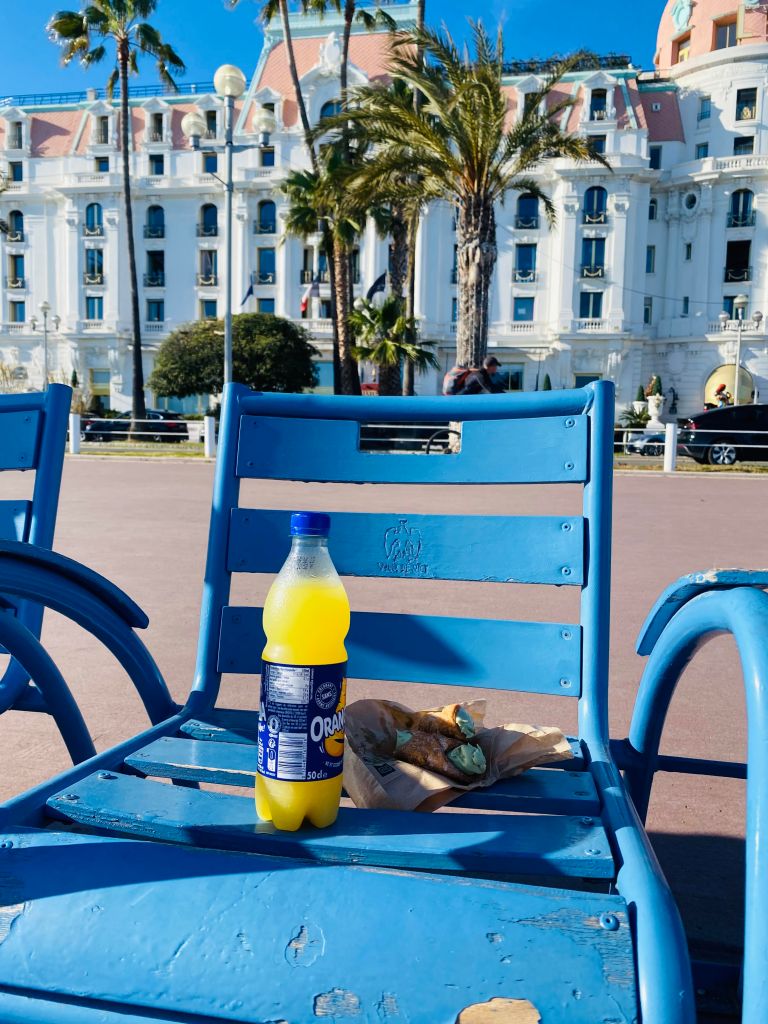
- The Promenade des Anglais. This is a wide, paved area that stretches the length of Nice’s coast. All the cities of the French Riviera have public sandy beaches, but Nice boasts a beautiful pebble beach (and by pebbles, I mean smooth gray stones the size of your palm) that is actually pretty comfortable. The water is the color of a blue raspberry Freeze Pop. There are beachfront cafés open from noon ‘til 5:00 where you can order food or just sit, relax, read a book and enjoy an Aperol spritz. If you don’t want to commit to a café, the whole Promenade is lined with iconic blue metal chairs to take in the view.
- Hotel Negresco. This beautiful hotel has a lot of interesting history, a gorgeous interior and a cupola designed by Gustave Eiffel (as in the Eiffel Tower), and doormen wearing top hats and tights. Definitely go to the bar if you want a ritzy night out.
- Old Town. At the end of the Promenade des Anglais is Nice’s Old Town, which is a triangle-shaped labyrinth of restaurants, clubs, bars, creperies, and souvenir shops. Old Town also hosts the Opéra de Nice, a beautiful opera house, and the flower market, the Cours Saleya.
- Cours Saleya. If you’ve seen To Catch a Thief, Cours Saleya is the flower market where Cary Grant gets chased by the police and beaten with a bouquet of chrysanthemums by an old lady cursing at him in rapid French. I promise that won’t happen to you, though. Cours Saleya is definitely tourist-trappy, but in a romantically French way, not in a corny way. Here you’ll find the juiciest, sweetest, most Instagrammable produce you’ve ever seen, crowded together with lemon trees, jasmine branches, lavender bunches, spices, bowls and platters carved from olive wood, and fresh croissants that are so warm and squidgy, you’ll have an out-of-body experience (no kidding). You’ll also find Chez Theresa, a stand famous for selling cheap Nicoise street food. I’d recommend the socca, a pan bagnat, and heck, another socca for the road. Nice hosts multiple outdoor markets which are worth exploring.
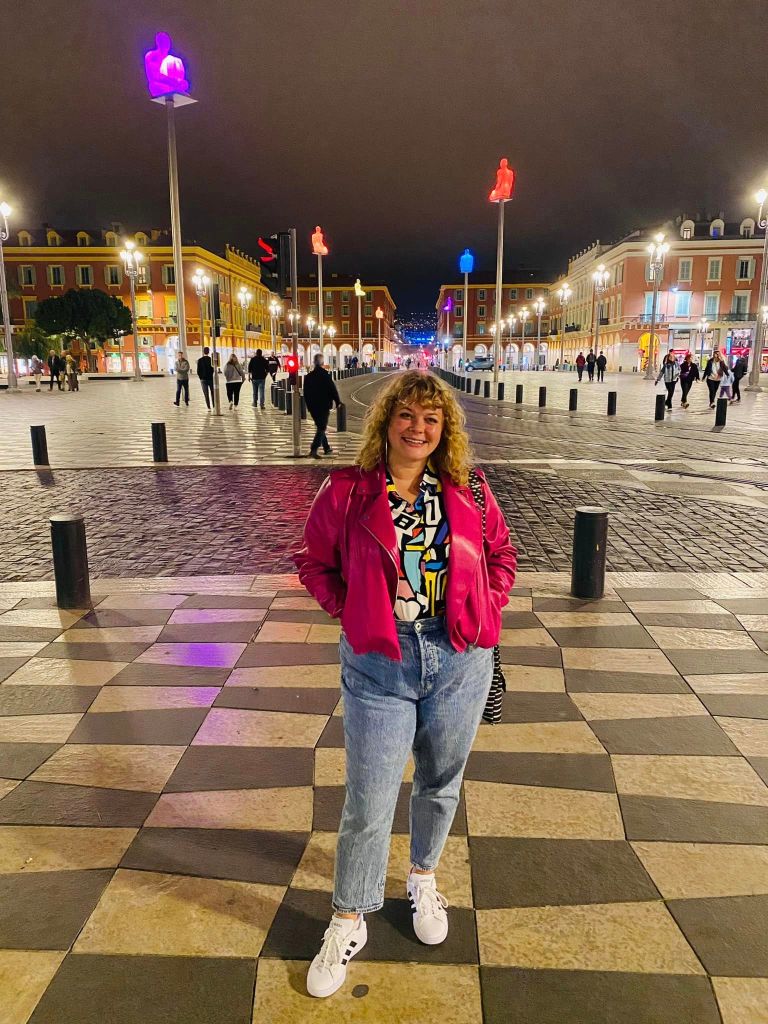
- Plaza de Massena. The gateway to Old Town, Plaza de Massena is a black-and-white checked city center where street performers play music and folks sit in those quintessential tiny tables and wicker chairs, enjoying an even tinier coffee. Check it out at night: there are statues perched atop high poles, and when the sun goes down, the statues are lit up like lollipops in bright colors.
- Nightlife. If you’re following my very good advice and staying in Nice, I’m guessing you’ll want to enjoy a little nightlife before drifting off into a wine-induced coma. If you’re reading this longform travel blog, I’m also guessing you’re in your late twenties to early forties, and you’re not trying to bump and grind to uhn-tss uhn-tss Europop EDM with a bunch of nineteen-year-olds. Whether you’re looking for a klubbb or, like me, a cozy little dive bar with good music, Old Town is a good choice either way. I would recommend Shapko. Shapko is everything you would imagine a French jazz club to be. A blonde woman outside smokes a cigarette and murmurs a mournful refrain into her phone. She’s polishing off a whole bottle of wine. Inside, velvet couches embrace shadowy nooks punctuated by wooden tables not much bigger than a dinner plate. The menu is a concise but respectable wine list and there’s an obligatory tap. The band is composed of four women with an identical cloudlike hairdo of tousled black curls and very chic boots. This band, eponymously named The Funky Chicks, looks as if they’ve raided Phoebe Buffet’s closet, which if you know me is the highest compliment I can possibly bestow. If Shapko weren’t so thoroughly hidden in the alleys of Old Town Nice, you would think this was all an elaborate ploy to appease the Americans trying to live that foux-du-fafa life.
Èze: Okay, there’s two Èzes. There’s Èze-sur-Mer, which literally translates to Èze-on-the-sea, and there’s Èze Village, which is a medieval village perched high atop the rocky cliffs overlooking the Mediterranean. You want to go to Èze Village, but if you take the train, it will take you to Èze-sur-Mer and suggest you catch a bus that only comes once an hour (lol) or hike an hour up the cliffside (oh god no). An Uber from Nice to Èze Village is about $25, so just do that. If you’ve been to Mont St. Michel near Paris, Èze has a similar setup: it’s a winding road that wraps around the rock of the cliffside, ending with a spectacular view on top. Seriously, do not miss out on this view. Walking through Èze and observing its many artsy shops is free, but if you want to see the view, spend $4 on a ticket to Le Jardin Exotique.


While you’re there, I would also visit the Fragonard Museum. France is famous for perfume, and Grasse (just north of Nice) is “The Capital of Perfume”. Grasse hosts three major perfumiers: Fragonard, Molinard, and Galimard. Fragonard is the most famous. You can go to the museum and see how perfume and beauty products are made, and if you book far enough ahead, you can make your own perfume at the perfume workshop (rule #3: make a reservation for all fun activities, like taking a boat ride, doing a workshop, or getting a tour/wine tasting). Now look, you can go all the way to Grasse to do this… but Èze Village also has a Fragonard factory/museum that does the same exact thing. I would hit up the perfume while you’re here and save yourself an hour-long train ride.

Menton: Menton is the last city before France turns into Italy. Seriously, the eastern edge of Menton is actually IN Italy. If you’re loving your French Riviera vacation but find yourself yearning for the sherbet-colored buildings and lemony brightness of the Amalfi Coast, then absolutely hit up Menton. Menton hosts La Fête du Citron, aka LemonFest, during the time of year when bourbon-loving Americans would begin to celebrate Mardi Gras. (All of these festivals and parades are a part of the Carnivale season, the time between post-twelve-days-of-Christmas Epiphany and pre-forty-days-of-Lent Easter). Menton purposefully sells everything that can be found in Amalfi: limoncello, lemon gelato, seafood, that GOOD good Italian pizza, as well as Provençal favorites like lavender and olive soap. If your husband is a cool nice person who thinks taking a thirty-minute Uber to a lemon farm so you can walk through lemon groves sipping limoncello and taking so many selfies is a good idea, then there are two lemon farms (La Maison du Citron and La Ferme Citrons) which will give tours and tastings. I WOULDN’T KNOW, THOUGH. I DIDN’T GO.


Monaco. I have way too much to say about Monaco to fit into this post. And I realize the irony here, because Monte-Carlo is the tiniest of all these coastal cities, but I promise next week to devote a gushy guide to the tiniest country/richest city in the world (sort of), as it deserves.
Antibes. If you’ve gone to Èze, Menton, Monaco, and Nice, I feel like you’ve gotten a good taste of the French Riviera. Locals suggest heading up to Saint-Paul de Vence for some killer views, so you might want to skip out on the west side of the French Riviera coast in favor of the mountainous north. For me, however, I had a date with destiny.


I am OBSESSED with Scott and Zelda Fitzgerald. He is my second favorite writer of all time (other than Shakespeare, sorry I’m an English teacher) and his rising-star-falling-comet life is possibly more interesting than his beautiful prose. A few years ago, Alex and I went to Asheville and saw the hotel where F. Scott Fitzgerald stayed and the asylum where Zelda met her tragic fiery end. Thus began our weirdest of hobbies: we have visited almost every home of F. Scott Fitzgerald’s. For our fifth anniversary, we drove three hours to Scott and Zelda’s Montgomery house, now an AirBnB, and spent the night in the place where Scott wrote Tender is Night, the semi-autobiographical work detailing their time living on the French Riviera in Antibes.
Technically, they lived in a villa in Juan-les-Pins, the even-richer-and-more-exclusive peninsula in between already-rich-and-exclusive Cannes and Antibes. When the Crash destroyed the Jazz Age, the Fitzgeralds moved out (Alex: “imagine moving from THIS to downtown Montgomery” Me: “they did” Alex: “wHAT”) and the mansion was converted into a five-star resort, Hotel Belles Rives. If you, like me, desire to be haunted by the ghostly author of the Great American Novel and his ghostly flapper muse, then staying at Hotel Belles Rives might be in your budget in March, when the hotel opens up just before the start of the season. It’s lovely and warm, and if you’re brave enough, there’s a beautiful cove to swim in.


Antibes wasn’t just a destination for the Fitzgeralds. Many famous artists, most notably Pablo Picasso, come to Antibes to get away from it all. I would recommend walking through Old Town Antibes and its artisan pottery stores, then visiting the Picasso Museum. Picasso was given the old Grimaldi (the ruling family of Monaco) castle as a workshop after WWII, and they’ve remodeled the place into a museum. Personally, my favorite part of the museum was Picasso’s tapestries (who knew he worked with different media? An art major, not me). My second favorite part was looking at this gigantic mural of a centaur with a straight-up smiley face painted on, next to a casting of Michelangelo’s men in chains. I’m pretty sure someone was making a joke.

Cannes.
Eh.
Look, if I had to rank these cities, one of them would have to be last, and that would be Cannes. Cannes is a beautiful resort city, but I, a poor commoner, do not care about resorts (unless they are the former home of F. Scott Fitzgerald). I was looking forward to Cannes for its cinematic importance. Cannes is the site of the Cannes Film Festival. Also, movies were invented by the French (not America, believe it or not). As a classic movie lover, I was looking forward to seeing some cinematic history, maybe going to a museum about the Cannes Film Festival, if not a museum that explores France’s history of film… only to find out that none of that exists. The best thing I could find was a mural, which at least paid tribute to the first science fiction movie, A Trip to the Moon (you know, the one where the moon is a face and the rocket hits him in the eye).


The worst part was, in addition to being deprived of cinematic history, Cannes was absolutely run over with important-looking men in expensive-looking suits in town for some kind of wealth management conference (gag). All of the cute restaurants were booked full, so we stayed long enough to find a local dive a few blocks away, had lunch, and peaced.
Take my advice and skip Cannes. Go to Saint-Paul de Vence, or take a boat ride, or do a wine tasting, or spend more time strolling along the Promenade. There’s something comforting about walking by the water, admiring the Belle Epoque architecture, imagining folks in parasols and top hats doing the same thing 150 years ago. No matter how many wars happen, how much technology changes the world, how many centuries pass: at the end of the day, we all just want to sit by the sea and enjoy the sun.
Part Two: What We Ate
Here are some Niçoise specialties that can be enjoyed anywhere along the French Riviera:


- Niçoise salad: duh. The Niçoise salad in its provenance is served a little differently than how we would prepare it in the states. (I grew up eating a salmon salad with roasted fingerling potatoes, blanched green beans, egg, and olives.) In Nice, the salad is prepared with tinned tuna (not fishy, really adds texture), capers and olives to add a briny level of saltiness, egg and tomatoes, and–surprisingly my favorite part of the salad–celery. Celery just adds a sweetness and crunch that brightens up the whole flavor palate of the dish. 10/10 salad; I don’t even think it had dressing because there were so many big flavors in harmony.

- Pan bagnat: this is the Niçoise salad version of a sandwich and you should definitely get one at Chez Theresa in the flower market. (Open 11–2; go for lunch!) Non-fishy tuna, olives, a slice of egg, and green peppers, onions, and radishes for a pleasant crunch. A pan bagnat at Chez Theresa will be served on a roll the size of your face, so maybe split one and get a slice of socca.
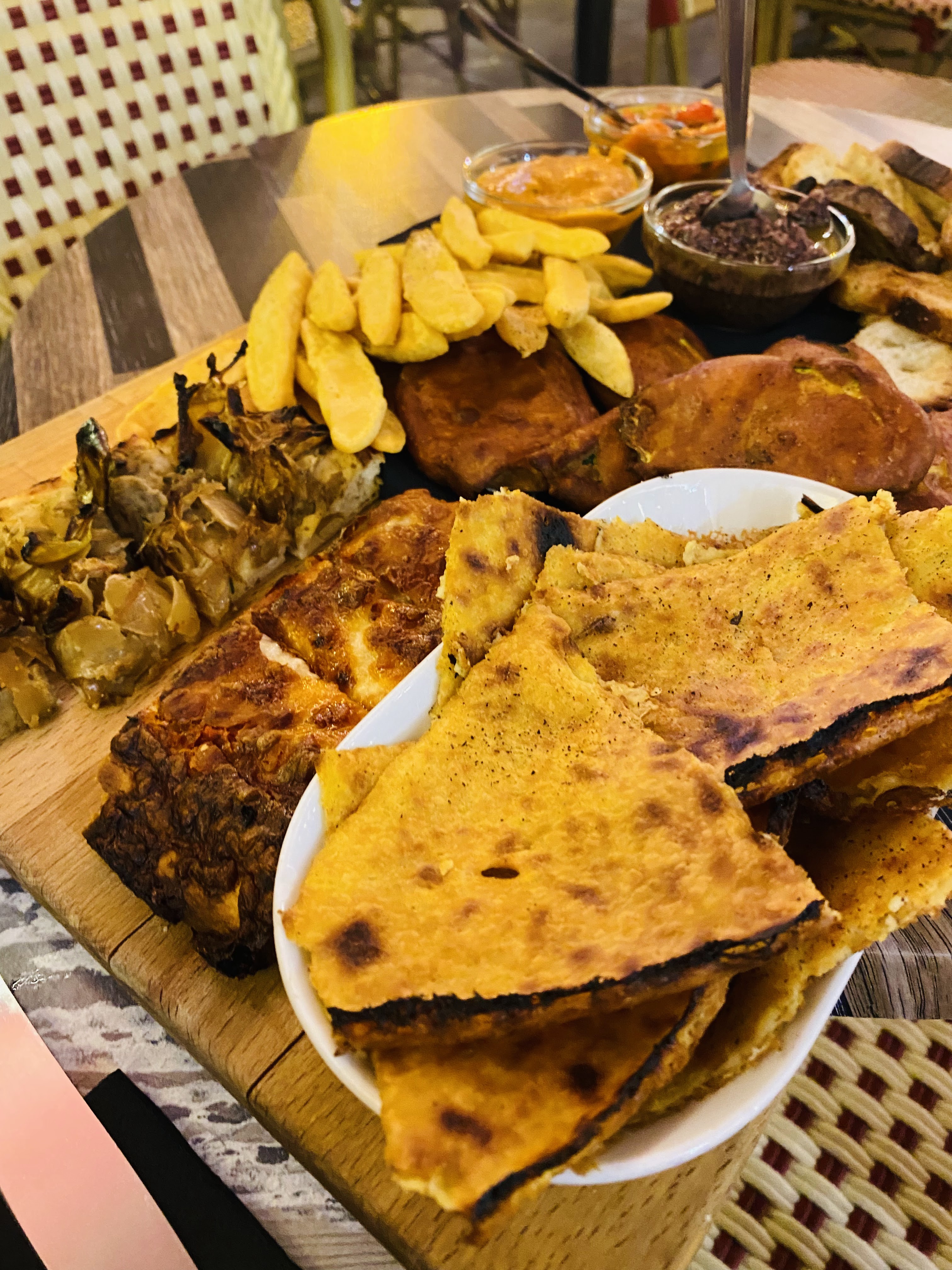
- Socca: how do I love thee, Socca? Let me count the ways. Have you ever eaten a squidgy French crepe, but you were like “dang I also love a good tandoori-cooked naan” and also the flavor profile of ciabatta? That’s socca. It’s a flatbread made of chickpea flour, olive oil, and rosemary. It almost looks like pizza, except it’s all squidgy and warm right out of the oven, and served in paper like a crepe. 11/10 street food. Definitely get a slice on your first day. Or two. Or five.
- Pissaladiere: Wherever they sell socca, they will also sell pissaladiere. This is basically a French-onion-flavored pizza. It’s served Sicilian-style, on ciabatta-like bread, and covered in caramelized onions. It’s “oh, alors” meets “mama mia”.
- Beignets: No, not those beignets. These are fried vegetables in a thick, fluffy batter. Beignets are seasonal, so depending on the time of year, you’ll get fried squash blossoms, eggplant, or zucchini. These are sweet-savory, and are served with homemade tomato sauce or olive tapenade.
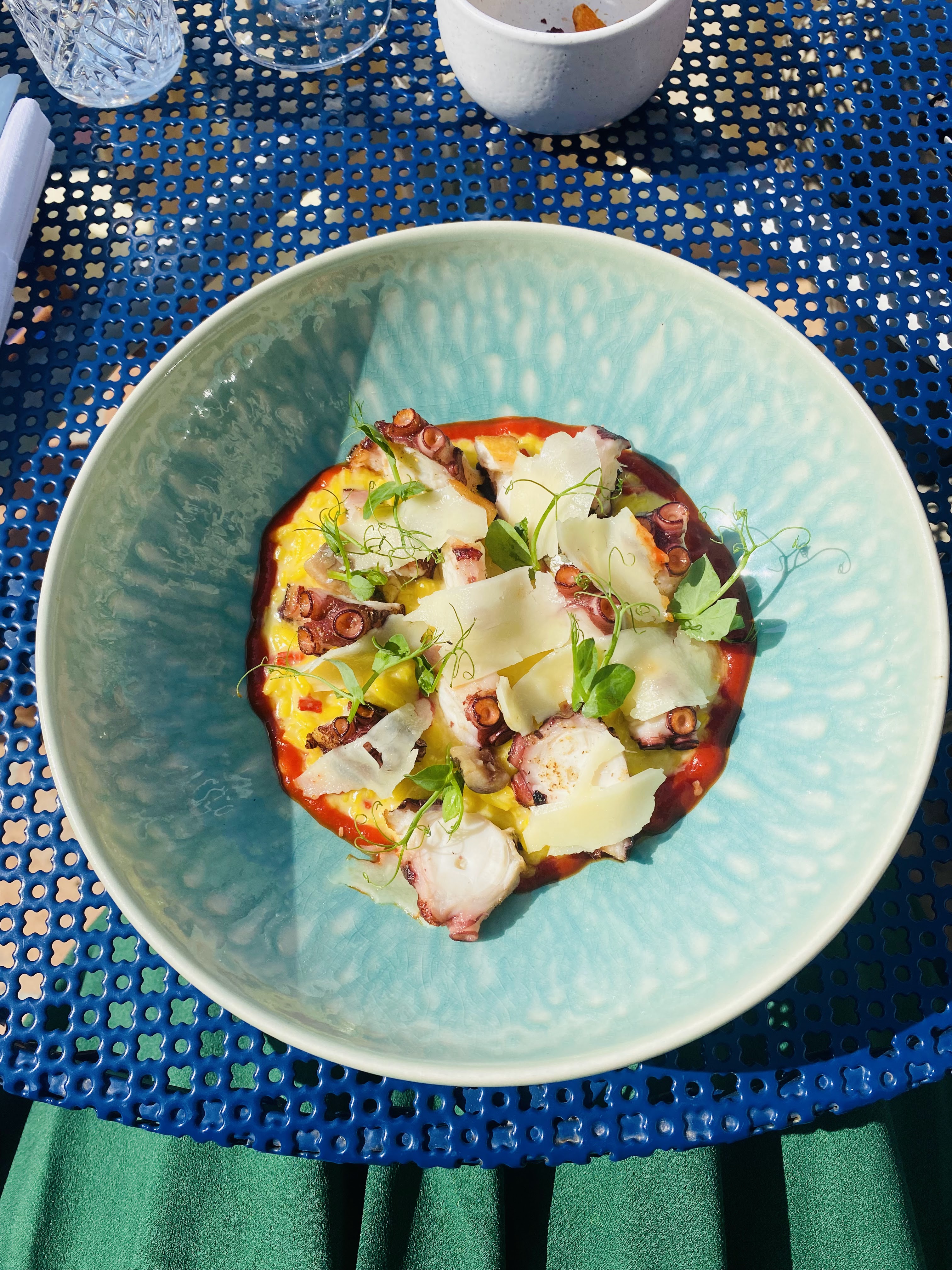

- Grilled octopus: Look, just try it. Octopus is really good, especially when it’s grilled. We don’t get a lot of it in America but it’s everywhere on the Mediterranean, so be daring! Just try not to think of “My Octopus Teacher” when you take a bite.
- Truffles: Because of the rocky coastal cliffs and the Maritime Alps in the distance, this area is also famous for its truffles. Truffle pasta, truffled potatoes, truffle gnocchi… you can even get truffle chocolate! (Not to be confused with chocolate truffles, which France definitely also has in spades.)
While you’re at it, don’t miss these Provençal dishes, since you’re in the best culinary country in the world:
- Croissants: okay OBVIOUSLY you’re going to get a croissant so it might as well top the list. The croissants and the pain au chocolat at the Cours Saleya (if you can get them warm and fresh) are so good, I had an out-of-body experience. Crispy, toasty-sweet, and flaky on the outside, squidgy and warm and string-cheese-pulley on the inside, and the chocolate in the pain au chocolat absolutely bursts in your mouth. God I’m making myself hungry


- Bouillabaisse: This dish is actually from Marseille, but I’m guessing you’re not going to shoehorn a trip to Marseille in your already-packed week on the Riviera, so try it here. Bouillabaisse consists of five different kinds of fish (mussels, shrimp, three different fish filets) and potatoes sitting in a rich, velvety red saffron broth. It’s served with toasted baguette slices and rouille. The best way I can describe rouille is it’s kind of like Chick-fil-A sauce, but if Chick-fil-A sauce had a really sexy French foreign exchange student staying at their house for the summer.

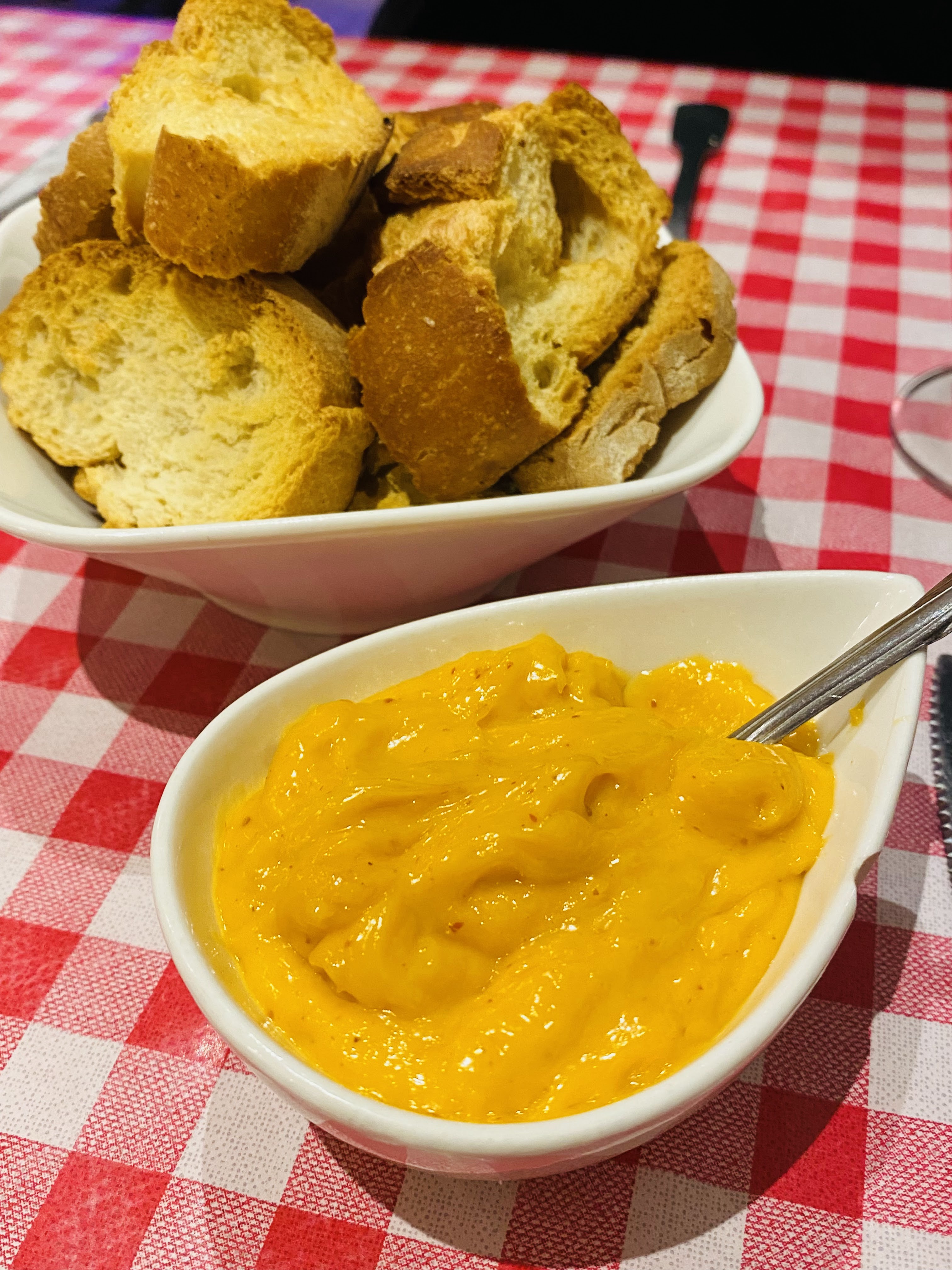
- Fish stew: Bouillabaisse is a laughably gigantic bowl of soup. Did you read the part where I said there were THREE fish filets, along with all the broth and the shrimp and the mussels? You won’t be able to finish it, and (I swear they all practice this beforehand), your waiter will come out to you with a hurt expression and say “aw, did you not like it?” So for those of you (not me) who aren’t trying to cram a whole Red Lobster platter into your tummy WITH stew, the French also serve just the broth. Fish stew is made from really good fish stock (I know, all of you “I just don’t like the taste of fish” folks are grimacing) that doesn’t taste fishy, it just tastes like a really good fish filet.
- Tarte tatin: This dessert isn’t even from anywhere close to Provence, but it’s nonetheless one of the most famous French desserts and worth a try. Imagine a pineapple-upside down cake, except in apple pie form. Caramelized apples are baked under a flaky pie crust, then the whole thing is flipped over and served with ice cream.

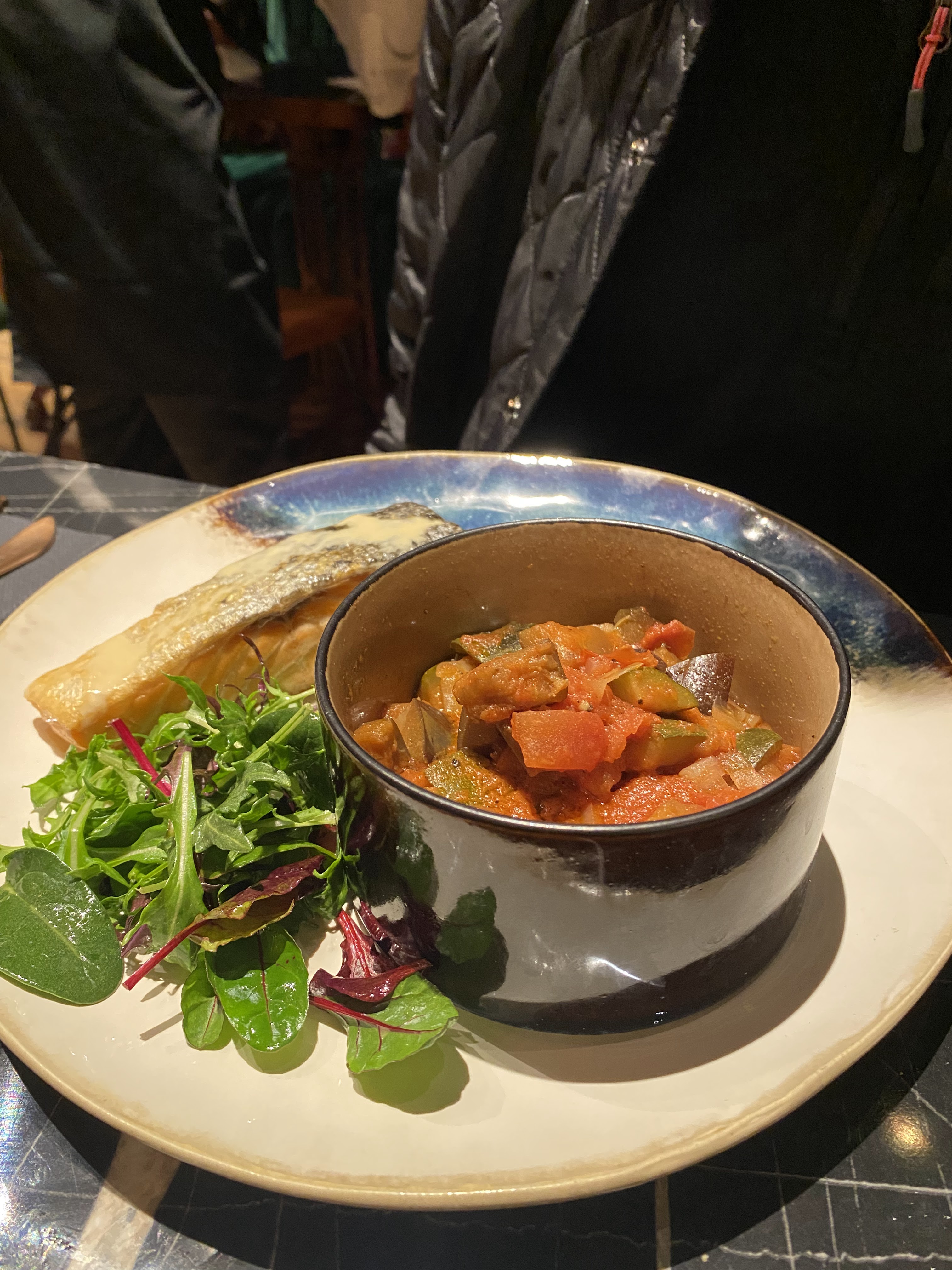
- Ratatouille: bro the ratatouille from Ratatouille isn’t even real ratatouille. This is a vegetable stew from Provence consisting of tomatoes, eggplant, zucchini and bell peppers. Served as a side in most Provençal restaurants, sans rat. Bone apple teeth.
In Paris, I would tell you to plan most of your budget around the food. In Nice, it’s pretty easy to find restaurants that will do a three-course meal for $19–30. If you’re trying to stay within budget, stick to restaurants that offer a Menu Du Jour with an entrée (appetizer), main, and dessert. Everything else on the menu will be $20-$30 per item, so it’s a weirdly good deal.


Remember to make a reservation if you have a specific place in mind or be willing to walk around/sit outside if you’re winging it. Also, in France, you need to ask for the check. They will let you sit there enjoying yourself and nursing one glass of wine until they literally close, so when you’re ready, flag your waiter down and politely ask for “L’addition, s’il vous plait” (the bill, if you please).
Are you intimidated by French menus? Don’t be. Many places offer an English menu. Also, Rule #6 of Traveling Well: most people speak English, but when in doubt, use the camera feature of the Google Translate app. You can hover over the menu and it will translate the whole thing for you. Finally, as a lover of French cuisine, it’s really easy to pick up on French food terms. Follow French cooking accounts on Instagram and begin taking notes, and you’ll be reading a French menu tout-suite.
Part Three: How We Packed
Traveling in Europe in the spring can be tricky. One, it’s still kind of cold, but on sunny days the Mediterranean sun will toast things up quite a bit, and two, it might rain. Now look, the Mediterranean gets 300 days of sunshine a year, but that’s during the on-season. You’re traveling in the cheap off-season, so pack a light raincoat and your coolest, most Instagrammable leather jacket.
As I stated before, you’re going to be walking everywhere (how do you think the French stay so thin?) so bring comfy shoes. I mean, don’t bring your grass-stained New Balances, but bring a comfy sneaker or flat and you’ll blend right in.
As for fashion, the South of France (especially in the off-season) is a scoshe more casual than dress-to-impress-Paris. Most people were walking around in trendy athletic wear, jeans, leather jackets and scarves, etc. But for goodness’ sake, don’t wear shorts and flip flops unless you’re going to the beach.
Nobody wears striped shirts in France except tourists, but Rule #3 of Traveling Well: you are a tourist. Be touristy. Pack that striped shirt and a cute scarf, eat your baguette fresh from the boulangerie, and go off, Brigitte Bardot!
For more pictures of the French Riviera and travel inspo, follow me on Instagram at instagram.com/rebeccamcqueenwrites!
 Ramblin' Reba


Leave a comment